

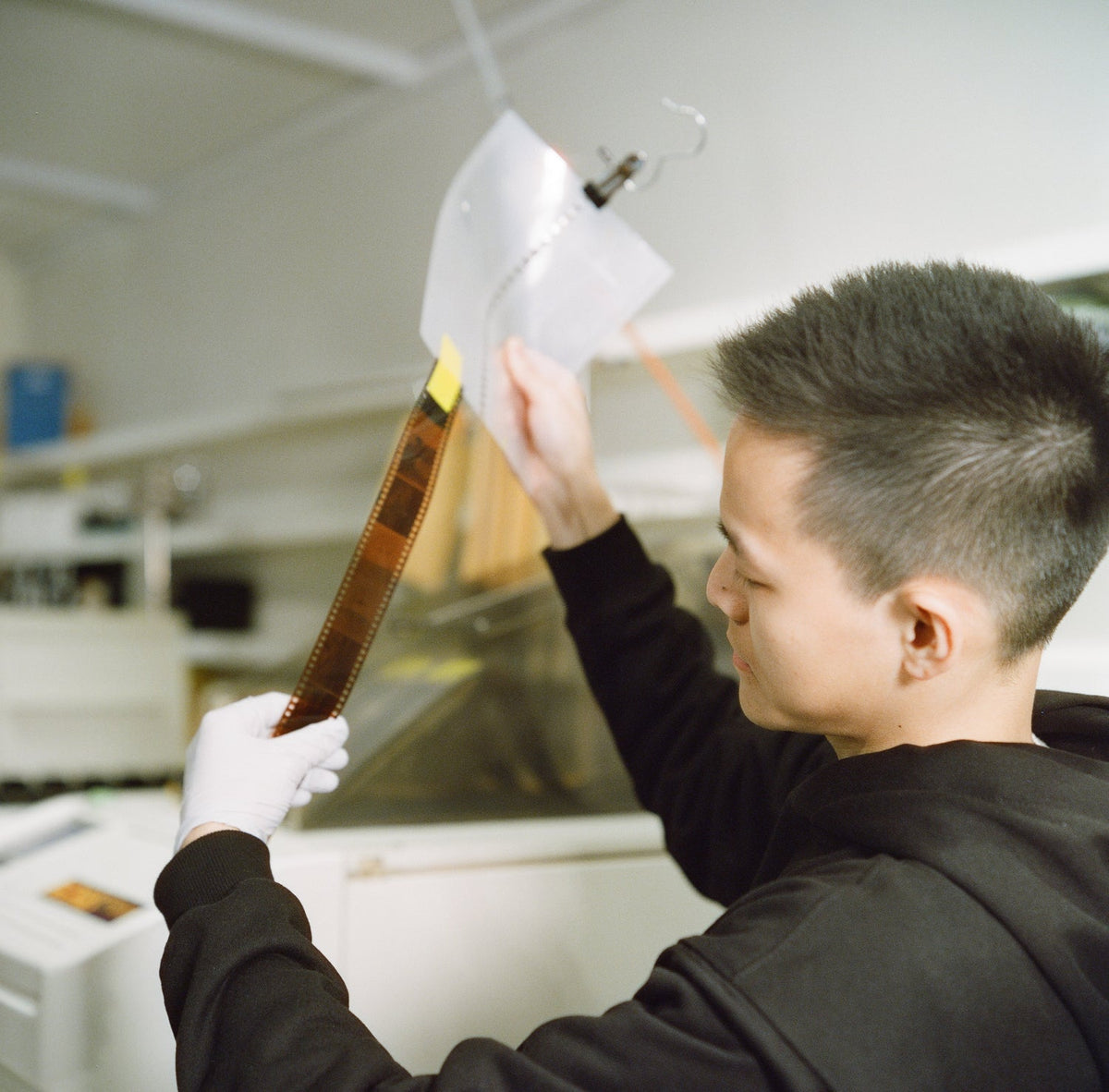
Before developing an old roll with Irohas Photo, check the stock and process marking, film format, storage history and any visible damage to its container. Do not open the cassette or unwind the film to inspect it. Age alone does not tell you whether images will survive, and the position of a film leader cannot prove whether it has been exposed. Keep uncertain film protected from light and ask the lab before ordering.

Key Takeaways
- Old film can show fog, reduced contrast or colour shifts. Results depend on the stock, exposure and storage history, not just its expiry date.
- Inspect the canister for rust, moisture damage, or loose ends before sending it in.
- A visible or retracted 35mm leader is only a clue: either can occur on a used roll. Neither proves whether photographs have been taken.
- Do not select black & white chemistry as a default rescue for unknown colour film. Identify the stock and confirm an appropriate service before processing.
What exactly are you working with?
An old roll may contain photographs, unused film or material that has already been processed. Keep those possibilities separate. We handle 35mm and 120 across the published processes, but that does not mean every historical stock or damaged roll is suitable for the current service. Photograph the label or container, keep any notes found with it and explain what you know about the camera and storage history.
How old is too old for developing old film?
There is no fixed birthday after which every latent image disappears. Equally, there is no reliable recovery rate for a roll whose exposure and storage are unknown. Heat, humidity and the particular stock matter as well as elapsed time. Some old film yields recognisable pictures and some yields little usable detail. Discuss expectations before paying for processing rather than treating a successful story about another roll as a forecast.
What film types can a lab handle?
Our published services cover C-41, traditional black & white, E-6 slide and ECN-2 film on Noritsu equipment, in 35mm and 120. Confirm acceptance when the stock is unidentified, deteriorated or marked for an older process. A camera collection may include film intended for chemistry that a present-day C-41 or E-6 line cannot simply replace. A legible label helps the lab answer that question without exposing the roll.
The format describes the film’s physical size, not its processing chemistry. A 35mm cassette and a paper-backed 120 roll can each contain different types of film. Do not identify one by an approximate container measurement alone. Record the brand, stock name, format and process marking where available. Photograph all sides of the closed package rather than pulling film out through the light trap.
How to tell if film has been exposed?
Treat unknown film as potentially exposed until you have better information. A handwritten note, original box or the history of the camera can help, but appearance rarely proves the answer. Do not open a camera back simply to look. If the camera may still contain film, tell the lab the model and condition and ask how to handle it without risking existing pictures.
Can a rewind knob show whether the film was used?
A rewind control can provide loading or transport information on some camera designs, but it is not an exposure-history indicator. Resistance depends on the mechanism and how film is engaged; a freely moving control can have several explanations. It cannot establish that a roll is fresh, shot or absent across all cameras. Do not force an unfamiliar control. Use the camera’s instructions, retain any frame-counter information, and ask before opening a potentially loaded body.
What can the film leader tell you?
For a 35mm cassette, the leader is the narrow tongue that may protrude from the light trap. Keep observations non-invasive:
- Photograph the cassette and any visible label or leader without pulling more film out.
- Keep any note saying “exposed”, the camera model or a shooting date with the roll.
- Tell the lab whether exposure is known or uncertain; do not treat leader length or shape as proof.
Some cameras rewind the leader fully inside, while others leave it out; a leader can also be retrieved after shooting. A missing leader therefore does not prove exposure, and a neat visible leader does not prove a new roll. Avoid testing the strip in room light. If you cannot establish its history, discuss the uncertainty and the processing charge before making a choice.
Can we still process the film if we are unsure?
Ask whether the film can be identified and accepted first. If exposure remains unknown, processing may be a reasonable choice when the possible photographs matter to you, but there is a chance of blank or unusable results. It is not automatically a black & white rescue job. Our C-41 service applies to suitable C-41 film; age alone does not establish which chemistry, special handling or timing is appropriate.
What condition is the film in?
Container condition and storage history help the lab assess the request, but they cannot reveal every problem inside. Look for visible rust, water damage, loose 120 backing paper or a damaged cassette, without opening it. Note whether the film came from a hot attic, damp cupboard or unknown location. A superficially tidy canister is not a guarantee that the hidden emulsion has remained sound.
How can we tell if the film is too fragile to process?
If you notice crumbling material, cracks, sticking layers or a strong vinegar-like smell, do not unwind the film to investigate. Some acetate film bases can deteriorate and become unsuitable for ordinary handling. Keep the material separate and ask the lab about acceptance before sending it. We do not advertise hand-tank or specialist conservation treatment as a standard Irohas service, so do not book an ordinary developing order on that assumption.
What happens if the film has mold or water damage?
Mould and water can damage an emulsion or cause layers to adhere, but the extent cannot be determined from the container alone. Do not wash, scrape or prise the roll apart at home. Describe visible contamination and send photographs of the exterior before posting. The receiving lab needs to confirm whether it can accept the material; an ordinary developing service is not a promise to separate or restore damaged film.
Our standard processing uses Noritsu equipment. A roll’s physical suitability still matters, especially if its base or backing paper is compromised. Do not assume that a machine can accept every old film, or that a different chemistry makes a fragile roll safe. For material outside the published service, discuss the limitation before booking; further assessment may be needed rather than an automatic processing choice.

Which process and lab should you choose?
Once the film has been identified, choose the process specified for that stock and check that its condition is acceptable. C-41, black & white, E-6 and ECN-2 are not interchangeable service levels. The decision should reflect both the actual film and what the lab can provide. Our developing and scanning overview explains the current services, without promising the recovery of every vintage roll.
What process does my old film need?
Start with the process instruction on the canister or box. If it is missing, ask before choosing: unknown film is not automatically C-41 or traditional black & white. Historical stocks may require a discontinued process, and already-developed strips need scanning rather than another development. Keep uncertainty visible in your message to the lab rather than trying to solve it by opening or cutting the film.
Before arranging processing, have these details ready:
- The stock name, format and process marking, or clear photographs if the identity is uncertain.
- Whether exposure is known, plus the camera or family history associated with the roll.
- Visible container damage, loose backing paper or the storage conditions you know about.
- A request for the lab to confirm acceptance, the appropriate service, expected timing and any limitations before you post.
- Whether you need Dev + Scan or Dev only, and how you want to collect or receive the physical film.
What do the standard processing services cost?
For suitable film accepted into the standard service, C-41 is A$17 for Dev + Scan or A$11 for Dev only; traditional black & white is A$19 or A$12. Prices are AUD per roll for 35mm and 120. Dev only does not include digital files. Cutting and sleeving are included unless you request uncut film. These are standard processing rates, not a specialist restoration quote; check our current prices and turnaround.
Process Type |
Dev & Scan |
Dev Only |
|---|---|---|
C-41 Color Negative |
$17 |
$11 |
Black & White |
$19 |
$12 |
Can I mail in found film from anywhere in Australia?
Our Australia-wide mail-in service lets you choose Melbourne, Sydney or Perth. For old or questionable film, confirm acceptance before posting, then include your packing list or order reference and use the matching lab address. We send a payment link after receiving and checking the rolls. Scanning orders receive a download link when processing is complete and payment is confirmed; transit is additional to lab time.
Keep a note of the approximate exposure date and storage history if available. “Unknown” is a useful, honest answer. Send the film promptly once acceptance and the service are clear, but do not assume faster processing changes the condition of the latent image already on the roll.
What results can you realistically expect?
The result may include recognisable photographs, heavy fog, weak contrast, colour casts, uneven frames or no useful images. Neither a successful recovery story nor the age printed on a box gives a dependable probability for your roll. Tell the lab what the photographs may mean to you, while keeping the outcome open. Standard processing cannot guarantee the return of a missing image.
How does age affect color and contrast?
Age and storage can affect sensitivity, fog and the latent image on unprocessed film. Colour balance and contrast may differ from a fresh roll, but there is no single cast that identifies all expired film. Processing the correct stock with the appropriate chemistry does not restore it to its original condition. Treat scanning adjustments as a way to interpret what remains, not proof that every lost tone can be recovered.
What do the final scans look like?
Dev + Scan includes high-resolution Noritsu files. Published 35mm full-frame dimensions are 4011 × 6048 pixels, approximately 24 MP; output varies for other formats. Scan resolution does not establish how much information survived on old film. Flextight scanning is a separate selected-frame service at A$20 per frame, not the default included scanner or a guaranteed recovery tool. Confirm its output and suitability before booking. Our JPEG vs TIFF scan guide explains file-format and print-size decisions before you order another scan.
FAQ
How do I identify the film type before sending it in?
Photograph the stock name, format and processing instruction on the closed container. Keep any original packaging or notes with the roll. Do not open the cassette or unroll backing paper to identify the film. If markings are missing or show an older process, contact the lab before ordering.
How can I tell if an old roll of film has already been exposed?
You cannot reliably prove exposure from rewind-knob resistance or leader length. Camera mechanisms and rewind behaviour vary. Treat an uncertain roll as potentially exposed, keep it protected from light and tell the lab what you know. Do not force controls or open a camera back to investigate.
What film processes does Irohas Photo accept for old film development?
Our listed processes are C-41, traditional black & white, E-6 and ECN-2 for 35mm and 120. Acceptance of an old roll depends on identifying its stock and confirming that its condition suits the service. Hand processing, clip testing and archival restoration are not advertised standard inclusions; ask about uncertain material before posting.
Conclusion
Keep the roll closed and its history together. Identify what you can from the exterior, confirm the service and its limitations, then choose whether you need scans. Digital files are stored for 60 days and negatives for 30 days after completion unless otherwise arranged. Download a backup and arrange negative collection or return. The aim is a careful, informed next step, not a promise about photographs that remain unseen.


